


Why secure code training doesn’t stack up (and what you can do about it)


Boring, boring, boring! That’s one of the main responses you’ll hear from developers whenever secure code training is mentioned. At Secure Code Warrior we believe there must be a better way, so we engaged with Evans Data Corp. to conduct primary research into developers’ attitudes towards secure coding, secure code practices, and security operations (download your copy of the whitepaper here).
In the soon-to-be-released Shifting from reaction to prevention: The changing face of application security, developers were asked about their main problems with current secure code training – and the answer was revealing.
Training that brings developers down

40% of surveyed developers felt that secure coding is taught in a vacuum. Another 40% felt the training was too theoretical, not related to their work, and not ‘hands-on’ enough. 30% identified a lack of training in the language:framework they work in every day. This is serious because it tells us that current secure code training is contextually irrelevant and has no meaningful relationship with what developers do every day.
For many developers, their main challenge is staying awake during mind-numbing, hands-off activities that are neither effective nor inspiring them to keep security front-of-mind.
Training in a vacuum prevents developers from making the cognitive links between the laboratory and the real world.
3 things developers want from secure code training:
- Overwhelmingly, developers say they want training that is more hands-on and more contextually relevant to their everyday work.
- 65% of developers say more training is required in language-specific vulnerabilities and the OWASP Top 10.
- 75% of developers surveyed prefer structured, on-the-job training.
Training that lifts developers up
When it comes to on-the-job training, developers bring with them a certain level of experience and existing knowledge. This points to the need for 'scaffolded’ learning. This is training that is structured – or scaffolded – to build on what the developer already knows. Scaffolded education both activates and enhances any prior experience while continuing to build new skills in bite-sized chunks. This makes it the perfect means for on-the-job learning.
Imparting skills that stick
When it comes to developer security training, we know that developers prefer the learn-by-doing method to the drudgery of theory-based static learning. In that sense, learning to code securely in a hyper-relevant, contextual environment is key. As champions of change in secure coding, Secure Code Warrior delivers contextual, hands-on education in relevant programming languages and frameworks, with challenges that mimic those developers face in the real world. Learning content includes over 5,500 challenges and missions covering over 147 different vulnerability types, including the all-important OWASP Top 10, OWASP Mobile Top 10, OWASP API Security Top 10 and CWE/SANS Top 25.
If you’d like to see the potential impact on your teams and their ability to deliver secure code faster, book a demo now.

.avif)
Boring, boring, boring! That’s one of the main responses you’ll hear from developers whenever secure code training is mentioned. At Secure Code Warrior we believe there must be a better way.
Secure Code Warrior makes secure coding a positive and engaging experience for developers as they increase their skills. We guide each coder along their own preferred learning pathway, so that security-skilled developers become the everyday superheroes of our connected world.
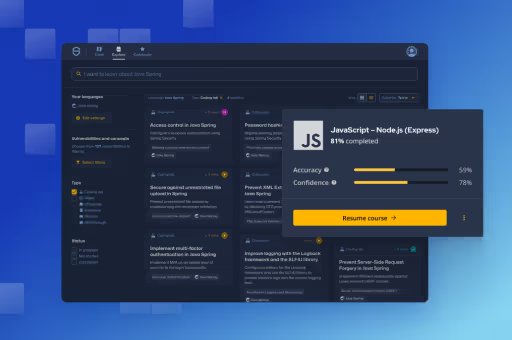
Secure Code Warrior is here for your organization to help you secure code across the entire software development lifecycle and create a culture in which cybersecurity is top of mind. Whether you’re an AppSec Manager, Developer, CISO, or anyone involved in security, we can help your organization reduce risks associated with insecure code.
Book a demo


Secure Code Warrior makes secure coding a positive and engaging experience for developers as they increase their skills. We guide each coder along their own preferred learning pathway, so that security-skilled developers become the everyday superheroes of our connected world.
This article was written by Secure Code Warrior's team of industry experts, committed to empowering developers with the knowledge and skills to build secure software from the start. Drawing on deep expertise in secure coding practices, industry trends, and real-world insights.
Boring, boring, boring! That’s one of the main responses you’ll hear from developers whenever secure code training is mentioned. At Secure Code Warrior we believe there must be a better way, so we engaged with Evans Data Corp. to conduct primary research into developers’ attitudes towards secure coding, secure code practices, and security operations (download your copy of the whitepaper here).
In the soon-to-be-released Shifting from reaction to prevention: The changing face of application security, developers were asked about their main problems with current secure code training – and the answer was revealing.
Training that brings developers down
40% of surveyed developers felt that secure coding is taught in a vacuum. Another 40% felt the training was too theoretical, not related to their work, and not ‘hands-on’ enough. 30% identified a lack of training in the language:framework they work in every day. This is serious because it tells us that current secure code training is contextually irrelevant and has no meaningful relationship with what developers do every day.
For many developers, their main challenge is staying awake during mind-numbing, hands-off activities that are neither effective nor inspiring them to keep security front-of-mind.
Training in a vacuum prevents developers from making the cognitive links between the laboratory and the real world.
3 things developers want from secure code training:
- Overwhelmingly, developers say they want training that is more hands-on and more contextually relevant to their everyday work.
- 65% of developers say more training is required in language-specific vulnerabilities and the OWASP Top 10.
- 75% of developers surveyed prefer structured, on-the-job training.
Training that lifts developers up
When it comes to on-the-job training, developers bring with them a certain level of experience and existing knowledge. This points to the need for 'scaffolded’ learning. This is training that is structured – or scaffolded – to build on what the developer already knows. Scaffolded education both activates and enhances any prior experience while continuing to build new skills in bite-sized chunks. This makes it the perfect means for on-the-job learning.
Imparting skills that stick
When it comes to developer security training, we know that developers prefer the learn-by-doing method to the drudgery of theory-based static learning. In that sense, learning to code securely in a hyper-relevant, contextual environment is key. As champions of change in secure coding, Secure Code Warrior delivers contextual, hands-on education in relevant programming languages and frameworks, with challenges that mimic those developers face in the real world. Learning content includes over 5,500 challenges and missions covering over 147 different vulnerability types, including the all-important OWASP Top 10, OWASP Mobile Top 10, OWASP API Security Top 10 and CWE/SANS Top 25.
If you’d like to see the potential impact on your teams and their ability to deliver secure code faster, book a demo now.


Boring, boring, boring! That’s one of the main responses you’ll hear from developers whenever secure code training is mentioned. At Secure Code Warrior we believe there must be a better way, so we engaged with Evans Data Corp. to conduct primary research into developers’ attitudes towards secure coding, secure code practices, and security operations (download your copy of the whitepaper here).
In the soon-to-be-released Shifting from reaction to prevention: The changing face of application security, developers were asked about their main problems with current secure code training – and the answer was revealing.
Training that brings developers down
40% of surveyed developers felt that secure coding is taught in a vacuum. Another 40% felt the training was too theoretical, not related to their work, and not ‘hands-on’ enough. 30% identified a lack of training in the language:framework they work in every day. This is serious because it tells us that current secure code training is contextually irrelevant and has no meaningful relationship with what developers do every day.
For many developers, their main challenge is staying awake during mind-numbing, hands-off activities that are neither effective nor inspiring them to keep security front-of-mind.
Training in a vacuum prevents developers from making the cognitive links between the laboratory and the real world.
3 things developers want from secure code training:
- Overwhelmingly, developers say they want training that is more hands-on and more contextually relevant to their everyday work.
- 65% of developers say more training is required in language-specific vulnerabilities and the OWASP Top 10.
- 75% of developers surveyed prefer structured, on-the-job training.
Training that lifts developers up
When it comes to on-the-job training, developers bring with them a certain level of experience and existing knowledge. This points to the need for 'scaffolded’ learning. This is training that is structured – or scaffolded – to build on what the developer already knows. Scaffolded education both activates and enhances any prior experience while continuing to build new skills in bite-sized chunks. This makes it the perfect means for on-the-job learning.
Imparting skills that stick
When it comes to developer security training, we know that developers prefer the learn-by-doing method to the drudgery of theory-based static learning. In that sense, learning to code securely in a hyper-relevant, contextual environment is key. As champions of change in secure coding, Secure Code Warrior delivers contextual, hands-on education in relevant programming languages and frameworks, with challenges that mimic those developers face in the real world. Learning content includes over 5,500 challenges and missions covering over 147 different vulnerability types, including the all-important OWASP Top 10, OWASP Mobile Top 10, OWASP API Security Top 10 and CWE/SANS Top 25.
If you’d like to see the potential impact on your teams and their ability to deliver secure code faster, book a demo now.
Click on the link below and download the PDF of this resource.
Secure Code Warrior is here for your organization to help you secure code across the entire software development lifecycle and create a culture in which cybersecurity is top of mind. Whether you’re an AppSec Manager, Developer, CISO, or anyone involved in security, we can help your organization reduce risks associated with insecure code.
View reportBook a demo
Secure Code Warrior makes secure coding a positive and engaging experience for developers as they increase their skills. We guide each coder along their own preferred learning pathway, so that security-skilled developers become the everyday superheroes of our connected world.
This article was written by Secure Code Warrior's team of industry experts, committed to empowering developers with the knowledge and skills to build secure software from the start. Drawing on deep expertise in secure coding practices, industry trends, and real-world insights.
Boring, boring, boring! That’s one of the main responses you’ll hear from developers whenever secure code training is mentioned. At Secure Code Warrior we believe there must be a better way, so we engaged with Evans Data Corp. to conduct primary research into developers’ attitudes towards secure coding, secure code practices, and security operations (download your copy of the whitepaper here).
In the soon-to-be-released Shifting from reaction to prevention: The changing face of application security, developers were asked about their main problems with current secure code training – and the answer was revealing.
Training that brings developers down
40% of surveyed developers felt that secure coding is taught in a vacuum. Another 40% felt the training was too theoretical, not related to their work, and not ‘hands-on’ enough. 30% identified a lack of training in the language:framework they work in every day. This is serious because it tells us that current secure code training is contextually irrelevant and has no meaningful relationship with what developers do every day.
For many developers, their main challenge is staying awake during mind-numbing, hands-off activities that are neither effective nor inspiring them to keep security front-of-mind.
Training in a vacuum prevents developers from making the cognitive links between the laboratory and the real world.
3 things developers want from secure code training:
- Overwhelmingly, developers say they want training that is more hands-on and more contextually relevant to their everyday work.
- 65% of developers say more training is required in language-specific vulnerabilities and the OWASP Top 10.
- 75% of developers surveyed prefer structured, on-the-job training.
Training that lifts developers up
When it comes to on-the-job training, developers bring with them a certain level of experience and existing knowledge. This points to the need for 'scaffolded’ learning. This is training that is structured – or scaffolded – to build on what the developer already knows. Scaffolded education both activates and enhances any prior experience while continuing to build new skills in bite-sized chunks. This makes it the perfect means for on-the-job learning.
Imparting skills that stick
When it comes to developer security training, we know that developers prefer the learn-by-doing method to the drudgery of theory-based static learning. In that sense, learning to code securely in a hyper-relevant, contextual environment is key. As champions of change in secure coding, Secure Code Warrior delivers contextual, hands-on education in relevant programming languages and frameworks, with challenges that mimic those developers face in the real world. Learning content includes over 5,500 challenges and missions covering over 147 different vulnerability types, including the all-important OWASP Top 10, OWASP Mobile Top 10, OWASP API Security Top 10 and CWE/SANS Top 25.
If you’d like to see the potential impact on your teams and their ability to deliver secure code faster, book a demo now.
Table of contents
Secure Code Warrior makes secure coding a positive and engaging experience for developers as they increase their skills. We guide each coder along their own preferred learning pathway, so that security-skilled developers become the everyday superheroes of our connected world.
Secure Code Warrior is here for your organization to help you secure code across the entire software development lifecycle and create a culture in which cybersecurity is top of mind. Whether you’re an AppSec Manager, Developer, CISO, or anyone involved in security, we can help your organization reduce risks associated with insecure code.
Book a demoDownloadResources to get you started
The Power of OpenText Application Security + Secure Code Warrior
OpenText Application Security and Secure Code Warrior combine vulnerability detection with AI Software Governance and developer capability. Together, they help organizations reduce risk, strengthen secure coding practices, and confidently adopt AI-driven development.


Secure Code Warrior corporate overview
Secure Code Warrior is an AI Software Governance platform designed to enable organizations to safely adopt AI-driven development by bridging the gap between development velocity and enterprise security. The platform addresses the "Visibility Gap," where security teams often lack insights into shadow AI coding tools and the origins of production code.

Secure code training topics & content
Our industry-leading content is always evolving to fit the ever changing software development landscape with your role in mind. Topics covering everything from AI to XQuery Injection, offered for a variety of roles from Architects and Engineers to Product Managers and QA. Get a sneak peek of what our content catalog has to offer by topic and role.

Cyber Resilience Act (CRA) Aligned Learning Pathways
SCW supports Cyber Resilience Act (CRA) readiness with CRA-aligned Quests and conceptual learning collections that help development teams build the Secure by Design, SDLC, and secure coding skills aligned with the CRA’s secure development principles.
Resources to get you started

Observe and Secure the ADLC: A Four-Point Framework for CISOs and Development Teams Using AI
While development teams look to make the most of GenAI’s undeniable benefits, we’d like to propose a four-point foundational framework that will allow security leaders to deploy AI coding tools and agents with a higher, more relevant standard of security best practices. It details exactly what enterprises can do to ensure safe, secure code development right now, and as agentic AI becomes an even bigger factor in the future.

La IA puede escribir y revisar código, pero los humanos siguen siendo los responsables del riesgo.
El lanzamiento de Claude Code Security por parte de Anthropic marca un punto de inflexión decisivo entre el desarrollo de software asistido por IA y el rápido avance de nuestro enfoque de la ciberseguridad moderna.